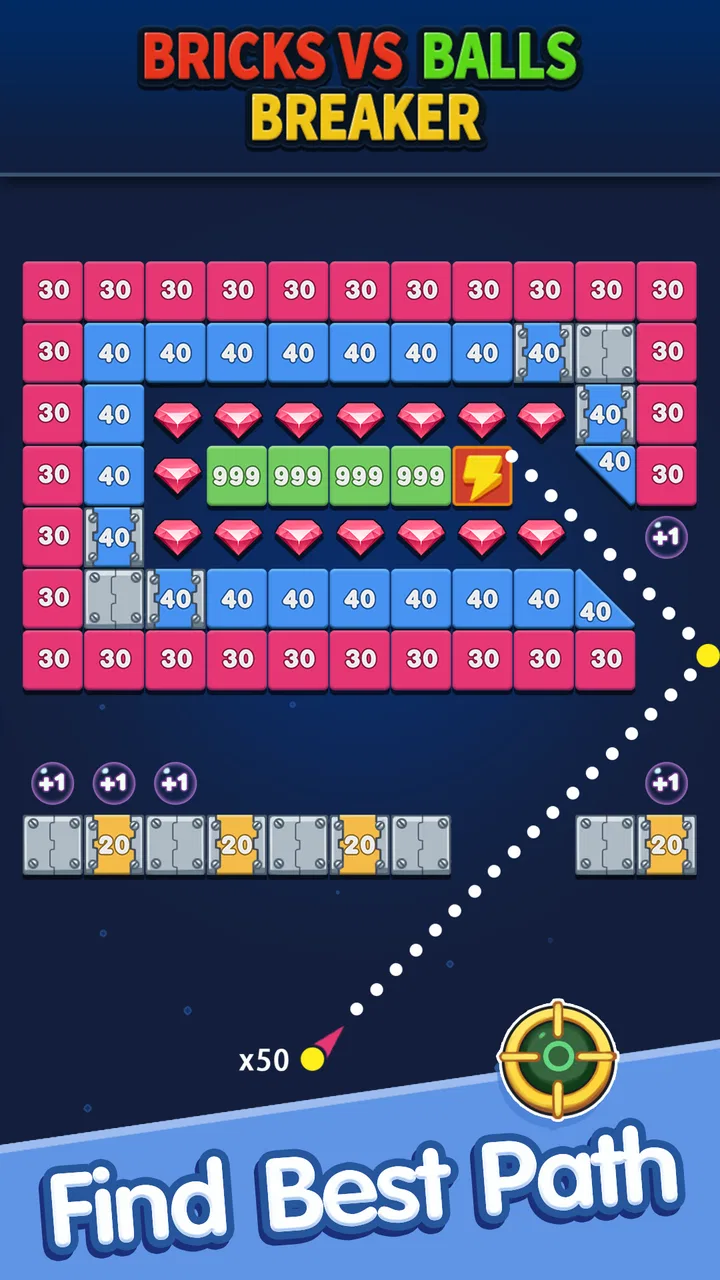
Bricks vs Balls Breaker
- 4.7
- Rating
- 10.00M
- Installs
- Free
- Price

 Analysis by App-foxy
I picked up Bricks vs Balls Breaker expecting a simple arcade time-killer, and that is exactly where its first appeal comes from. The idea is easy to understand: aim a shot, let balls bounce through a brick layout, and try to clear the screen before the arrangement becomes too difficult. I did not need a tutorial-heavy introduction or a long explanation of rules. Within a few attempts, I was already adjusting angles and looking for better openings.
That simplicity makes it especially comfortable on a phone. I can play with one hand while waiting for coffee, take a short turn between tasks, or stop after a single attempt without feeling that I have abandoned a larger session. It is a free arcade game from Bricks Ball Games, aimed at Everyone, and its broad appeal is easy to understand. The game has reached over 10 million installs and holds a 4.7 average from around 51 thousand ratings, which fits my impression that its basic loop is immediately approachable.
Why the first week feels so satisfying
The strongest part of the opening week is the small amount of thought hidden inside each shot. At first, I naturally aimed at the most obvious brick. That worked often enough to feel rewarding, but the better decisions came from studying the whole arrangement. A shot that hits several bricks in sequence can be more useful than one that removes a single target, and a carefully chosen angle may create a longer chain of rebounds than a direct attack.
You May Also Like

 Blood Strike: 2.5 Anniversary
Blood Strike’s Loadouts Turn Every Drop Into a Tactical Gamble
A close look at Blood Strike’s custom loadouts: how fast access to signature weapons reshapes its battle royale rhythm, rewards preparation, and narrows the gap between fights.

 Pandora - Music & Podcasts
Pandora’s Music Is Easy to Start, but Harder to Recover
Pandora’s strength is its low-effort path from a seed to a station. Its weak spot is how much confidence it asks you to place in connection, setup, and quiet recovery.

 8 Ball Pool
 Is Built on Rivalries, Rematches, and Routine
A close look at the rivalries, rematches, shared routines, and unanswered safety questions that turn a quick pool match into a persistent mobile community.

 Samsung Music
’s Quiet Strength Is Playing What You Already Own
Its reach comes less from spectacle than from dependable access to a personal library. That simplicity is both the app’s strongest retention engine and its ceiling.

 AccuWeather: Weather Radar
AccuWeather Review: A Quick, Clear Forecast for Everyday Decisions
For everyday plans, the best forecast is the one you can understand quickly. AccuWeather makes rain timing, radar, and local conditions easy to act on, with a few trade-offs.

 Hill Climb Racing
Why Hill Climb Racing Still Turns Crashes Into One More Run
A tiny car, a bumpy hill and one more upgrade: Hill Climb Racing keeps resurfacing because its simple chaos makes every near-miss feel personal.
More From Our News Desk



This is where the game feels more like a puzzle than a reflex arcade title. There is no need to tap rapidly or memorize complicated controls. I spend my attention on trajectory, contact points, and the order in which obstacles should disappear. The satisfying moments are not purely lucky: when a ball travels through a crowded section and returns to clear an awkward corner, I can usually trace that success back to a sensible angle.
The short-session design also helps the first impression. A game like this does not demand a quiet room or a large block of free time. I can begin, make a few decisions, and put the phone down. That makes it a better fit for small breaks than arcade games built around long runs or constant reaction speed. It is also more forgiving for players who enjoy casual puzzle solving but do not want a demanding competitive environment.
My most useful early habit was to stop aiming only for immediate damage. I started checking where the first rebound would send the ball and whether that path would reach a cluster afterward. This simple change made the game feel less random. When the layout looked crowded, I also preferred opening a route through several weaker blocks instead of spending the shot on a stronger block with no useful follow-up.
That approach reveals one of the title’s quiet strengths: it rewards patience without becoming slow. I can take a moment to line up a shot, but the result still has enough movement and unpredictability to remain entertaining. The bouncing sequence supplies the visual payoff after the decision, so even a modestly good plan can feel exciting when the chain develops.
It is worth being clear about what this game is not. It is not a deep strategy game with a wide set of systems to learn, and it is not a precision action game where every moment tests coordination. Its pleasure comes from repeating a familiar action while gradually improving judgment. Players looking for elaborate character progression or a rich narrative will probably find the experience too narrow. Players who want a clean, instantly readable arcade puzzle are much more likely to enjoy it.
The small decisions that make ordinary rounds better
I found that the best way to play is to treat each turn as a problem of positioning rather than simple removal. If several bricks are arranged so that a ball can pass through a gap and rebound into another section, that gap becomes more valuable than the nearest target. I also learned not to rush a shot simply because one brick appears easy to hit. A convenient hit can leave the next layout less manageable, while a slightly less obvious angle may create a much better clearing route.
Another practical tip is to watch the return path, not just the launch path. The first contact is only the beginning of the shot. A ball that enters at a shallow angle may spend longer moving across the field, while a steep angle can return quickly and produce fewer useful contacts. Thinking about both halves of the journey gave me more control and reduced the feeling that success depended entirely on chance.
For a realistic everyday example, I would use it during a commute with several short pauses rather than during a dedicated evening gaming session. I might play one round while waiting for an appointment, close it when my name is called, and return later without needing to remember a complicated story or team setup. That is a genuine strength, but it also points toward the game’s eventual limitation: once the basic aiming lesson has been learned, the same kind of decision repeats frequently.
What remains useful after the novelty fades
The more important question is whether the game earns a permanent place on my phone after the first week. For me, the answer depends on what I want from an arcade game. If I value a dependable, offline-friendly distraction, it has recurring value. Its store summary specifically presents it as a no-Wi-Fi game, and that makes it practical for travel, waiting rooms, or places where I do not want to rely on a stable connection.
That convenience is more meaningful than it may sound. Many mobile games are designed around checking in, connecting, or maintaining a longer session. This one works better as a self-contained activity. I can use it when I have only a few minutes and do not need to coordinate with anyone else. It is also suitable for people who prefer not to commit to a multiplayer match or a game that punishes them for leaving suddenly.
Its month-to-month value comes from the natural appeal of trying to improve decisions that initially felt automatic. I still get something from returning when I approach the layouts with a different mindset: look for a better opening, preserve a useful angle, and avoid wasting a shot on a target that does not improve the next exchange. That kind of self-improvement is modest, but it can be enough for a casual player who enjoys polishing a familiar routine.
At the same time, I would not pretend that every return feels fresh. The central action remains aiming and watching balls bounce through bricks. If I play for too long in one sitting, the pleasure becomes repetitive because my attention is focused on variations of the same task. The game works best in short bursts, and I think that is an important part of its long-term identity rather than a flaw to ignore.
Compared with a traditional brick-breaker, this version feels more deliberate and puzzle-oriented. Classic brick-breakers usually place more emphasis on controlling a paddle in real time, reacting to a moving ball, and surviving continuous action. Here, the key decision happens before the shot, so I have more time to reason and less pressure to react instantly. Compared with match-three puzzle games, it offers fewer types of moves but gives each angle more physical consequence. A match-three player may prefer variety in combinations; this game is better for someone who enjoys trajectory and rebound planning.
It also differs from endless-runner arcade games in a useful way. I am not steering through a constantly changing stream or relying on reflexes to avoid immediate hazards. That makes it calmer and more accessible, especially when I am tired. The trade-off is that it lacks the rush and movement that keep endless runners exciting for players who want continuous action.
How I would manage the free-to-play side
The game is free to download and play, but in-app purchases range from $0.99 to $104.99 per item. That range is important for anyone deciding whether the game can remain a comfortable casual hobby. I would approach the purchase system cautiously and decide in advance whether I am happy to play within the free experience. A short arcade session can lose some of its relaxing quality if I start treating every difficult moment as a reason to spend.
My advice is to judge the game by its ordinary loop before considering any optional purchase. If aiming, bouncing, and clearing bricks are already enjoyable, the game has a reason to stay installed without extra spending. If the basic loop feels repetitive from the beginning, paying will not solve that underlying issue. The most sensible use case is to treat purchases as optional convenience rather than as part of the reason to install the game.
This is also where the game may not suit everyone. Players who dislike free-to-play structures, who want a fully paid experience with a clearly bounded cost, or who feel pressure when optional items appear may prefer a premium arcade alternative. I would also recommend looking elsewhere if you need a large variety of modes, a story, or a strong social layer. The focused design is its advantage for quick play, but it limits how many different reasons I have to return.
Maintenance, friction, and the habits that keep it enjoyable
From a maintenance perspective, the game is easy to keep around because it does not demand much attention outside the moments when I choose to play. There is no personal routine I need to maintain, no long-term team to manage, and no complicated progress system that requires daily care. That makes it less burdensome than many mobile games that turn entertainment into a schedule.
Still, low maintenance does not mean unlimited usefulness. The game can become background clutter if I leave it installed but only open it out of habit. I get the most value when I give it a specific role: a short offline distraction, a gentle puzzle break, or a way to occupy a few unplanned minutes. Without that role, it is easy for the loop to blur into the many other casual games on a phone.
One maintenance habit I found helpful was setting a natural stopping point. Instead of continuing until the game feels dull, I stop after a small number of attempts or when I notice that I am firing without considering the angle. This preserves the satisfying part of the experience. Because each shot is self-contained, there is little benefit in forcing a long session after concentration has dropped.
The minimum operating requirement is Android 6.0, and the current version is 2.4.3. For someone using a compatible Android phone, that makes it a relatively accessible option across older and newer devices. I would still think about how the game fits into my personal phone habits: if storage, notifications, or purchase prompts are concerns, those practical details matter more than the attractive simplicity of the core mechanic.
Its Everyone age rating also matches the straightforward presentation. I would consider it suitable for family-friendly casual play, especially for someone who wants a game that can be understood quickly. That does not mean every child will find it engaging for long; the appeal depends on enjoying careful aiming and repeated attempts rather than on characters or a story world.
Where fatigue appears over repeated sessions
The biggest source of fatigue is repetition in the decision pattern. Even when the brick arrangement changes, I am still evaluating the same questions: where to aim, which contact creates the best rebound, and whether a shot can clear a cluster. That consistency is excellent for learning, but it can also make the experience predictable after the initial discovery period.
A second source of tiredness is the tension between control and bounce behavior. I can choose the launch direction, but the full result unfolds through multiple contacts. When a shot goes poorly, I may understand why, yet still feel that the outcome was less satisfying than a direct puzzle move. On the other hand, that uncertainty is also responsible for the most entertaining chain reactions. The game lives in that trade-off: too much control would make it dry, while too much randomness would make careful planning feel pointless.
I also noticed that the game is less suitable when I want a strong sense of progression. A player who needs new mechanics, changing objectives, or a narrative reason to continue may run out of motivation. The recurring reward is mainly the pleasure of solving the next arrangement more effectively. That is enough for a certain kind of player, but it is not a universal long-term hook.
The best way to avoid fatigue is to change the context rather than expect the game to become a different genre. I use it for brief pauses, not as my only game. I may play it after a more demanding task when I want something quiet, or during travel when connectivity is inconvenient. Alternating it with a story-driven game, a competitive title, or a more varied puzzle game keeps its narrow focus feeling intentional instead of monotonous.
There is also a useful distinction between relaxing repetition and empty repetition. When I am actively looking for improved angles, the repeated structure feels calming and skill-based. When I am launching shots automatically while distracted, it becomes forgettable. That means the game rewards a small amount of attention but does not require intense concentration. It is at its best in the middle ground.
My long-term verdict for different kinds of players
After the novelty fades, I still see a legitimate place for this arcade puzzle game, but not as a universal recommendation. I would suggest it to someone who enjoys physics-like rebounds, short sessions, and the satisfaction of improving a simple technique. It is particularly convenient for offline moments and for players who want to pause at any time without losing the thread of a larger adventure.
I would be more hesitant with a player who needs constant novelty, deep progression, competitive interaction, or a clear ending. That person may enjoy the first few sessions and then move on quickly. I would also point free-to-play-sensitive users toward a different option if the stated purchase range feels uncomfortable. The free entry is helpful, but the long-term experience should be judged by whether the core loop remains enjoyable without turning optional spending into a goal.
Bricks Ball Games has kept the concept focused rather than overloaded. That focus is why the game is easy to recommend as a casual download, and it is also why I would not describe it as a complete all-purpose gaming experience. It fills one narrow need well: a quick brick-clearing puzzle where a thoughtful angle can create a surprisingly satisfying chain.
My final view is that it earns lasting space when I use it deliberately. I would keep it installed as a lightweight, no-Wi-Fi arcade option, open it for short sessions, and stop before the repeated aiming loop turns into noise. Its free price, Everyone rating, broad install base, and strong average reception make it approachable, but those details do not replace personal fit. The real test is simple: if planning one more rebound still feels rewarding after the first week, this is a small game with durable everyday value.
FAQs for Bricks vs Balls Breaker
01What is Bricks vs Balls Breaker?
Bricks vs Balls Breaker is a casual arcade game in which you launch a stream of balls toward numbered bricks to reduce their strength and clear them from the board. Each turn requires you to choose an angle carefully, use walls for rebounds, and remove as many blocks as possible before they reach the bottom. It is easy to learn but becomes more strategic as levels progress.
02How do you play Bricks vs Balls Breaker effectively?
The main objective is to destroy every brick before the blocks move too far down the screen. Instead of aiming only at the nearest brick, look for angles that allow the balls to bounce several times and hit multiple targets. Prioritize bricks with high numbers, collect extra balls whenever possible, and use side walls to extend each shot. Careful positioning usually matters more than quick tapping.
03Is Bricks vs Balls Breaker free to download and play?
Bricks vs Balls Breaker can generally be downloaded and played without an upfront purchase, making it accessible for casual players. However, free versions may include advertising, optional purchases, or other monetization features depending on the platform and current release. Before downloading, check the official store listing for the latest information about ads, in-app purchases, permissions, and any premium options.
04Does Bricks vs Balls Breaker require an internet connection?
The basic brick-breaking gameplay is typically suitable for short offline sessions, which makes the game convenient for travel or moments without reliable connectivity. Nevertheless, some features may depend on an internet connection, including advertisements, cloud saving, updates, leaderboards, special events, or purchases. Availability can vary between Android and iOS versions, so test the game offline after installation if this is important to you.
05Is Bricks vs Balls Breaker suitable for children and casual players?
Bricks vs Balls Breaker is generally easy for beginners because its controls are simple and the core concept can be understood within a few minutes. It does not require advanced gaming experience, although later stages may demand patience and planning. Parents should still review the age rating, advertising, in-app purchase settings, and privacy information, especially if children will play on a shared device.
Pros
- Simple controls make it easy to start playing immediately.
- Short levels fit well into quick gaming sessions.
- Brick layouts offer satisfying chain-reaction shots.
- Works well for casual
- offline entertainment.
- Gradual difficulty helps maintain a steady challenge.
Cons
- Some levels may feel repetitive after extended play.
- Random brick layouts can make difficulty feel inconsistent.
- Extra balls and boosters may encourage in-app purchases.
- Ads can interrupt the flow between rounds.
- Precision aiming is less comfortable on smaller screens.

Bricks vs Balls Breaker
Gallery